Myob vs Xero: Which software is better for SMEs in 2026?




Both Xero and Myob are leading cloud-based accounting software providers across Australia and New Zealand, but their approaches differ. Myob segments its small- to medium business offering into a mobile app for solopreneurs and the self-employed, and online accounting software (Myob Business Lite and Myob Business Pro). Xero focuses heavily on providing comprehensive, integrated cloud accounting software that helps SMEs run their finances end-to-end.
This article breaks down the Myob product ecosystem, pricing, features and AI capabilities and compares it directly with Xero.
Quick Overview
Myob is the better option for trade or product-based businesses because it offers inventory tracking and tap-to-pay features on the lower-priced plans. It also has a powerful mobile app for solopreneurs and freelancers. Xero is the better option for SMEs that require heavy third-party integrations alongside a comprehensive accounting tool.
Table of Contents
- Myob vs Xero: Quick Product Comparison
- Core Myob features
- Core Xero features
- What SMEs usually like most about Myob vs Xero
- Conclusion
- FAQs: Myob vs Xero
Myob vs Xero: Quick Product Comparison
| Feature | Myob | Xero | |||||
|---|---|---|---|---|---|---|---|
| Pricing |
|
|
|||||
| Included in plans | 30-day free trial, cloud access, data migration | 30-day free trial, cloud access, data migration | |||||
| Users |
|
Unlimited | |||||
| Support | 24/7 chat support, AI BAS (no phone support) | Xero Central, JAX – AI Agent | |||||
| G2 Review | 3.6/5 | 4.4/5 | |||||
| Popular for | Inventory management, payroll functionality and the solo traders app. | User-friendly accounting software and unlimited users. | |||||
| Key difference | Developed for Australia and New Zealand | Global accounting package | |||||
| Stand-out feature for SMEs | Built-in business management tools | Powerful mobile app, large app marketplace, strong accountant adoption | |||||
| Best for | Australian and New Zealand startups and growing businesses. | Self-employed Startups Growing businesses |
Core Myob Features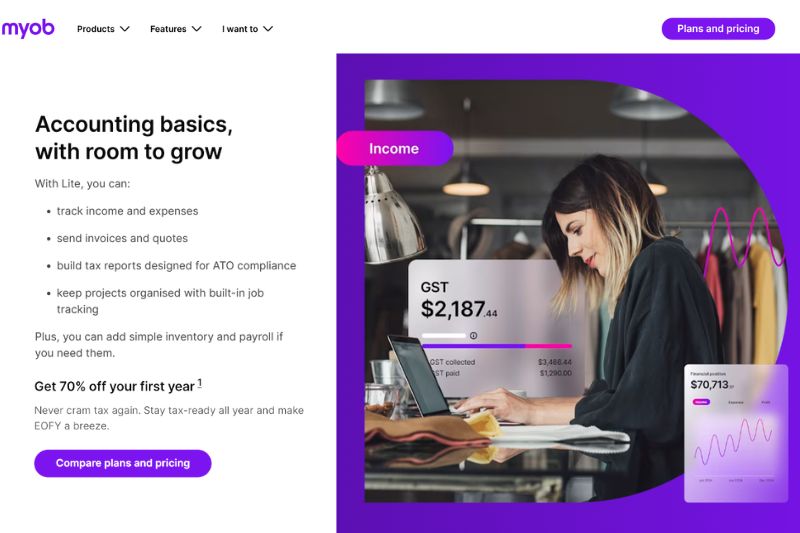
Myob provides SMEs with a fully-fledged accounting software suite that includes AI tools to reduce admin, smart apps for on-the-go bookkeeping, and standard accounting features, including unlimited invoices and quotes.
1. AI tools
Myob is increasingly integrating AI tools into its platform to align with other accounting systems. AI capabilities provide business owners with intuitive support when setting up the platform, entering financial data and preparing financial reports.
AI BAS (currently in beta) assists businesses with their Business Activity Statement preparation and workflow. It facilitates data gathering, transaction categorization, data reconciliation, and verification of compliance with GST rules. It also provides clear AI explanations, enabling you to review and submit your BAS on time. AI BAS is available on Solo, Lite and Pro.
Smart Invoice Reminders (SIR) is an AI-powered tool that takes the hassle out of getting paid by reducing the admin burden. Myob generates reminders and sends them to customers, automatically updating your invoice dashboard. It also suggests actions you can take on overdue invoices. SIR is available in Lite and Pro.
2. Smart apps by MYOB
Myob has recently expanded beyond desktop and browser accounting into mobile-first business tools for SMEs.
Solo by Myob is designed for freelancers, sole traders, and self-employed professionals. The comprehensive mobile tool helps business owners manage accounting processes on the go. Providing unlimited invoicing, expense tracking, tap-to-pay functionality and mobile bookkeeping. Users can access accounts anytime, anywhere, enabling real-time financial management.
The Myob Assist app pairs seamlessly with any subscription, preventing tedious admin from piling up. It lets you create unlimited invoices and quotes, and scan receipts with your mobile phone. This helps you streamline bookkeeping tasks with auto-matching and category suggestions running in the background. It’s easy to create quotes on your phone and convert them to invoices in an instant. Share documents with customers instantly and get paid online, all tracked in the mobile app.
Further reading: How to organize receipts for small business using automation
3. Accounting features
For small- to medium-sized businesses, Myob offers software designed for real business situations. Income and expense tracking, GST tracking, BAS lodgement, online payments, bank feeds and connections, and financial reporting form the core foundation of the accounting software.
One outstanding benefit of Myob is that you can create unlimited invoices and quotes without paying extra. Online payments can be made with one click, and automated invoice reminders are sent directly to customers. This makes the invoicing and payment process easier by reducing admin. This is one of the areas where Myob directly compares itself with Xero.
Where Myob shines is in its payroll and inventory management functionality. Unlike its competitors, Myob offers payroll services for $3 per employee, making it accessible to small businesses. Manage payroll processing, employee benefits and timesheets in one place. A decent inventory management function is available on lower-priced plans (Lite and Pro). This isn’t common among most accounting platforms, setting Myob apart from its peers.
The bottom line: Choose Myob if you value mobility, comprehensive accounting, inventory management and compliance-heavy workflows.

Xero Core Features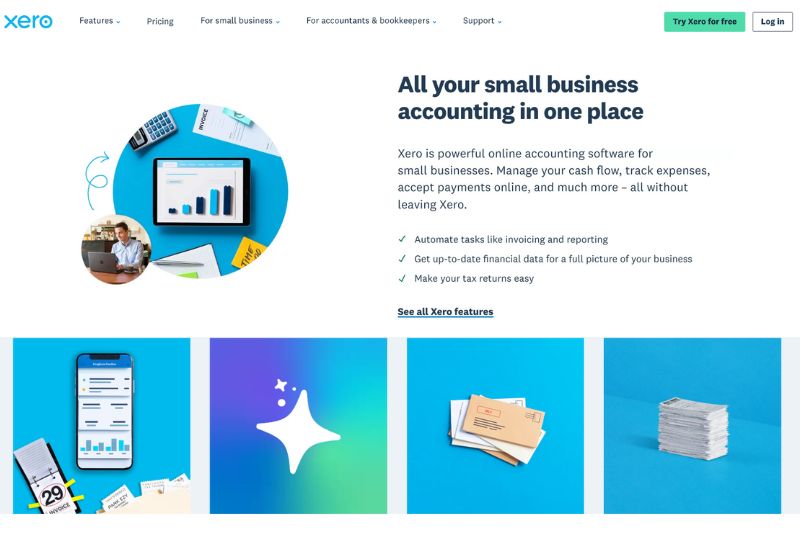
Xero is a popular global accounting system that offers an extensive integration capability, a robust AI tool (JAX), and modern reporting functionality. Businesses that already use well-known apps and want their platforms to interact will prefer Xero to Myob.
1. Cloud accounting ecosystem
Xero has been built as a connectivity-first cloud-based platform. One of its biggest strengths is its extensive integration marketplace. This allows businesses to expand their functionality and continue working on platforms they already have. It also empowers rapidly growing small businesses to add payroll, CRM, ecommerce, and payment gateways.
Compared with Myob, Xero focuses heavily on app integrations. This has made Xero very popular with businesses that rely on widely used platforms such as Slack, Shopify, Hubspot and Paypal or Stripe.
Xero also supports unlimited users on all plans. This makes collaboration with business partners, accountants, tax professionals and finance teams easier. For businesses with distributed teams and external partners, Xero is preferred over Myob.
2. AI-driven bookkeeping
Xero has expanded the capability of its bookkeeping function with its AI agent, Jax (Just Ask Xero). JAX acts like a business companion, helping users to complete every step of their bookkeeping tasks. As it learns more about your business, it begins to anticipate what steps you need to take to manage finances from start to finish.
JAX gets involved in automated payment reminders, transaction matching, cash flow management and expense categorization to reduce manual data entry. Businesses looking to improve automation can also explore how invoice approval workflows and AP automation integrate with cloud accounting systems
While both Myob and Xero have integrated AI agents, Myob focuses heavily on BAS preparation, while Xero is positioned around productivity insights, automation and complete day-to-day financial visibility and control.
3. Scalability and reporting functionality
For startups and growing businesses, Xero offers a scalable accounting and business software. It is widely recognised as easy-to-use software that offers a good mix of basic accounting features, robust reporting, third-party app integration, and payment system integration. Non-accountants will easily adapt to its intuitive AI-driven prompts and suggestions.
Compared with Myob, Xero’s reporting functionality is viewed as more intuitive and modern. This is one of the reasons it has strong adoption among accountants in Australia, New Zealand and globally.
The bottom line: Choose Xero if you value simplicity, automation, mobility, ease of use and integrations.
What SMEs usually like most about Myob vs Xero
| Myob | Xero |
|---|---|
| Built-in compliance support | Extremely intuitive interface |
| Strong payroll tools on lower-priced plans | Fast onboarding |
| Australian/New Zealand tax compliance | High-quality mobile application |
| Unlimited quotes and invoices on lower plans | Connection of bank accounts and automated bank feeds |
| ERP upgrade path | Project management and time tracking capabilities |
| Inventory management on lower plans | Massive third-party app marketplace |
Conclusion
The most accurate description of how Myob differs from Xero is that Myob is designed to facilitate real-life business practices in Australia and New Zealand. It is a business-first platform that integrates financial management into a more comprehensive system. This gives companies full oversight with heavy compliance workflows. Xero has a broader global objective and needs customisation through third-party apps to achieve the same level of business management.
- If you’re a sole trader, freelancer, self-employed individual, or an SME in Australia or New Zealand seeking compliance with local tax and business regulations, choose Myob.
- If your business already uses popular third-party apps (like Shopify, HubSpot and Envoice’s approval automation) and you need an accounting platform to integrate other business processes with your finances, choose Xero.
FAQs: Myob vs Xero
1. Which is better, Myob or Xero?
The best accounting platform varies depending on the type of business, location, user expectations, and the use of third-party apps. Myob is better suited to businesses that need accounting, GST, payroll, and compliance in Australia and New Zealand. Xero is the preferred choice for global companies looking for a modern, cloud-based platform with unlimited users and a strong focus on third-party integrations.
2. Is Xero easier to use than Myob?
Xero is considered a simpler, more intuitive platform than Myob. It is widely recognized for its simple user interface, customizable dashboard and cloud-native design. This makes adoption by first-time users and small business owners faster, with a lower learning curve than Myob. Users find that tasks such as invoicing, bank reconciliation, and expense tracking require fewer steps in Xero.
3. How do Myob’s advanced features compare with Xero?
Myob offers better operational features than Xero, such as inventory management, payroll and compliance workflows. The biggest difference is that Myob offers these features natively while Xero depends on third-party integrations. Myob also includes some of these features in its lower-priced plans, unlike many of its competitors. For example, in Myob’s Lite plan, payroll is included, providing access to single-touch payroll, automated superannuation contributions and employee self-onboarding.
4. Can you switch from Xero to Myob easily?
Yes, the switch from Myob to Xero is relatively easy but requires careful planning. You can use a free conversion service for up to two years of data, or manually export data from spreadsheets. Myob recommends you make the switch after the financial year-end, as some data cannot be transferred and must be saved in reports. Other data will need to be loaded manually. Myob provides a guide to making a DIY move from Xero to their platform.
Produced by our content partners and reviewed by Envoice’s internal experts to ensure it reflects real accounting workflows and accurate product usage.
Articles you might like


STAY ALWAYS TUNED
Subscribe to newsletter
Still not sure?
- Don’t spend time on manual work
- Streamline bookkeeping processes with AI
- Automate invoice processing
- Integrate with the tools you rely on every day