What is an e-invoice and when should you implement it?



Produced by our content partners and reviewed by Envoice’s internal experts to ensure it reflects real accounting workflows and accurate product usage.
Over the next five years, the European Union is set to enact a significant transformation in how invoices are created, shared, and processed between businesses. By July 1, 2030, intra-EU B2B transactions will be subject to mandatory electronic invoicing.1 This pivotal policy shift follows similar mandates already adopted by Latin America, Asia, and European countries. It is only a matter of time before other countries follow suit to keep up with global business practices.
In this article, we discuss what an e-invoice is, why it’s being mandated across the globe, and how companies can get ahead of the curve by implementing electronic documents as a business best practice.
Quick Overview
An e-invoice is short for electronic invoicing, and is a digital version of a traditional paper invoice. An e-invoice is a structured, readable document transmitted between a seller and a buyer in a standardized format. The e-invoice serves the same purpose as a traditional invoice: to request payment for goods or services provided.
Table of Contents
- How is an e-invoice different from a traditional invoice?
- How is electronic data interchange regulated in different countries?
- How you can implement e-invoicing in your business
- Takeaways
- FAQs: What is an e-invoice?
How is an e-invoice different from a traditional invoice?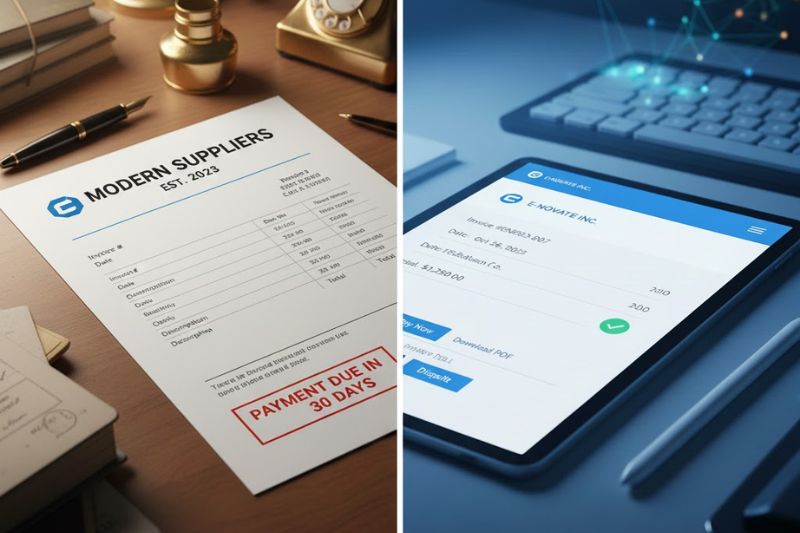
Traditional invoicing
Traditional invoicing (or unstructured data invoice) is the use of paper documents, PDF or Word formats, unstructured HTML invoices (web-based), or images (JPEGs, PNG, TIFF). These formats are easy for humans to read but harder for machines to interpret, so they still require manual data entry.
These formats also make exchanging invoices B2B (business-to-business) difficult and require the use of technology such as optical character recognition (OCR) software. With OCR, business systems can process scanned paper invoices, but even this technology has limitations. For instance, OCR can read text but cannot validate whether the information on the invoice is correct.
Electronic invoicing
Electronic invoicing, on the other hand, is a structured digital format that compliant accounting systems can process automatically. These formats are:
- XML: eXtensible Markup Language. Unlike HTML, which has predefined tags, XML allows users to define custom tags tailored to their data needs. XML excels at electronic data exchange between disparate systems, such as databases, websites, and applications, without losing information.
- UBL: Universal Business Language. Based on XML, UBL is the universally accepted format for structuring and encoding data. It allows systems to automatically import and process invoice data.
Both XML and UBL enable global interoperability across systems, standardizing and simplifying digital trade. It also enables the automated processing of invoices, which is superior to manual processes.
Some benefits of automated invoice processing are:
- A faster and more efficient accounts receivable and accounts payable process.
- Eliminating manual data entry reduces error rates and fraud.
- The introduction of digital signatures offers stronger security features.
- Better tax compliance and adherence to continuous transaction controls (transaction-based reporting).
- Facilitation of business transactions between organizations worldwide by removing the constraints of traditional invoices.
Increase your understanding: Electronic Invoicing 101 – How To Take Full Advantage of It
Why is the trend towards e-invoicing growing worldwide?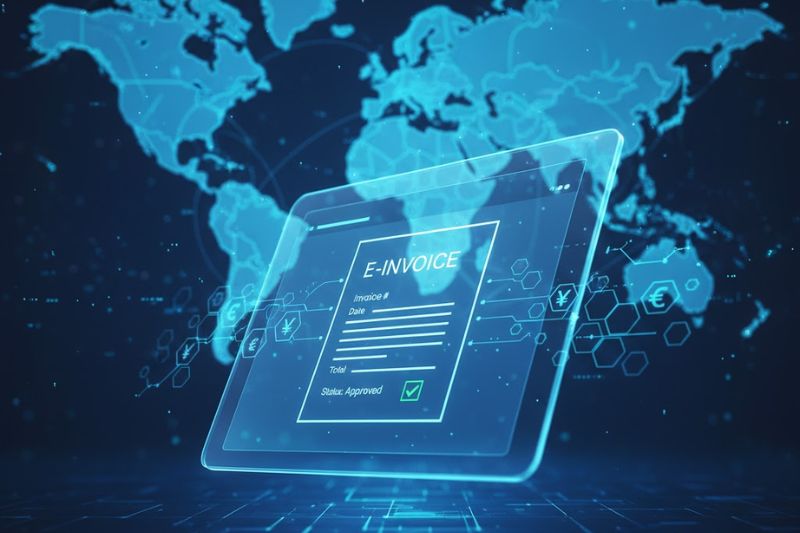
There are two main reasons for businesses to transform their invoicing processes:
- Meeting the requirements of tax models that require real-time visibility into financial transactions (CTC models).
- To benefit from the cost savings and increase operational efficiencies provided by automated e-invoicing (discussed above).
The rise of CTC e-invoicing models
As of today, more than 70 countries globally have introduced some form of a CTC (continuous transaction controls) tax model. CTC is the real-time reporting of transaction data to tax authorities. This trend is expected to become common practice by 2030. This differs from the periodic transaction controls (PTC) model, in which businesses submit reports monthly, quarterly, or annually.
E-invoicing was first introduced in Chile (2001), to address gaps in Value Added Tax. Its success motivated Brazil and Mexico to follow suit, with Europe adopting the system when Denmark (2005), Turkey (2011), and Italy (2014) became the pioneers of mass B2B e-invoicing. The following countries currently have CTC-based invoicing:
- Latin America: Mexico, Brazil, Argentina, Chile
- EU: Italy, Hungary, Spain, Poland, Portugal and France (2026), Belgium (2026), Ireland (2028-2030), Slovenia, Estonia, Slovakia (2027)1
- Asia: India, Turkey, Vietnam, South Korea, Malaysia and Singapore
- Middle East: United Arab Emirates, Saudi Arabia
- Africa: Egypt, Kenya
As more countries worldwide transition from unstructured invoice data to a structured electronic format, it is anticipated that invoice automation and digitization will become the norm.
Get ahead of electronic invoicing while you’re not under regulatory pressure.

With Envoice, you can activate e-invoicing in minutes. With support for the global Peppol network and the European e-invoicing standard (EN 16931), you can receive machine-readable invoices from anywhere in the world. 👉 Sign up for an Envoice free trial.
How is electronic data interchange regulated in different countries?
The shift to electronic invoicing (e-invoicing) and electronic supply chain documents is fundamentally a global regulatory movement driven by government agencies seeking better tax transparency and efficiency. However, Electronic Data Interchange (EDI) regulation is handled by each country through various data interchange networks.
| Network | Where it’s used | Model | Scope |
| Peppol | Europe, Asia-Pacific, parts of the Middle East and North America | 4-cornermodel2 using standardized BIS/UBL documents | The most internationally adopted interoperability framework is increasingly used for cross-border trade and national B2B mandates (e.g., Singapore, Japan, Australia, and France’s upcoming rollout). |
| National Clearance Platforms | Latin America, parts of Europe, Asia, and the Middle East | Businesses submit invoices to the tax authority for real-time validation before delivery to the buyer. | These systems dominate in countries with Continuous Transaction Controls (CTC) and influence global compliance design. |
| Government E-Invoicing Portals | Europe and emerging markets | Centralized government systems for B2G and increasingly B2B invoice exchange. | Growing rapidly due to EU-wide mandates, designed to standardize domestic e-invoicing and improve tax oversight. |
| Accredited Provider Networks | Middle East, Asia | Governments certify private platforms that validate, register, or transmit e-invoices on behalf of taxpayers. | A hybrid model that combines government oversight with private-sector technological scalability. |
How you can implement e-invoicing in your business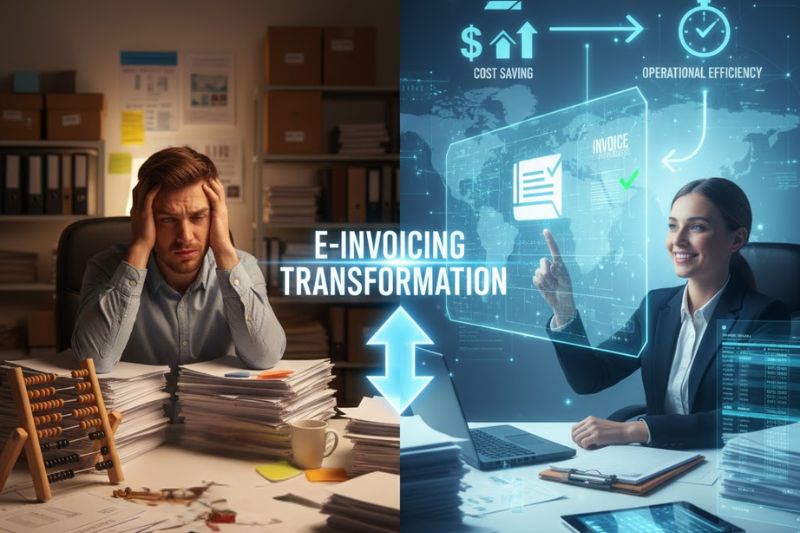
Adopting e-invoicing starts with choosing the right software to generate structured invoices and connect to the networks required by your customers and tax authorities. Begin your investigation with these popular choices 👇
- Best E-Invoicing Software To Try in 2026
Step-by-step implementation plan
- Identify compliance and network needs for your country and the countries you do business with.
- Set key performance goals for implementation. Be specific about what success will look like. E.g., Reduce invoice cycle time by X days.
- Finalise your e-invoice software selection.
- Design mapping and document templates.
- Test the end-to-end process.
- Pilot with a small customer group/supplier.
- Update procedures and train staff.
- Onboard remaining suppliers/customers.
A successful implementation will eliminate paper invoices and streamline the process from creation to archiving. There should be no manual workarounds, and the aim is to see a visible improvement in the time your employees spend on strategic financial tasks. Check for automatic adherence to tax regulations through built-in validations and seamless integration with your ERP system or accounting system.
Lastly, the most important indicator of a successful implementation will be: Real-time visibility over the movements of financial transactions.
Find out how the e-Residency Hub in Estonia put Envoice to work and achieved 40% annual growth. 👉 How e-Residency Hub serves over 800 customers with Envoice.
Takeaways
- Electronic invoicing is the use of structured data invoices, such as XML, that allow for the transmission and reading of data between businesses.
- The main reason for the increase in e-invoices is the growing popularity of CTC tax models worldwide.
- Electronic formats are not just about regulations; they also open up the way for more efficient invoicing processes and cost savings.
- The transformation to an e-invoice system begins with choosing the right software to meet regulatory requirements and your business needs.
👉 Ready to transform your invoicing process with Envoice e-invoicing?
FAQs: What is an e-invoice?
1. How does an electronic invoice work?
Digital invoicing (e-invoice) works by automatically exchanging data in a machine-readable format, such as XML, between buyer and seller ERP systems. This involves creating a digital document using invoicing software and transmitting it (often via open platforms or an e-invoicing service provider). Before invoices reach accounts payable, they are checked for validity and to ensure compliance with e-invoicing standards. The system then completes a 3-way match and sends the invoice for approval and payment.
2. What is the difference between an e-invoice and a normal invoice?
An e-invoice is a structured data format that allows for encrypted file transfer between trading partners. Transaction data is transmitted in the Universal Markup Language, enabling invoice data to be read by different business systems. A normal invoice is unstructured invoice data issued as a paper document, PDF, or web-based invoice.
3. Is e-invoicing suitable for the accounts receivable process?
Yes, electronic invoicing can be highly beneficial for the receivable process. It automates creation, delivery and tracking of invoice status, leading to a shorter payment cycle, better cash flow management, and fewer errors.
4. Which countries have global e-invoicing mandates?
Latin America, Europe, and Asia are currently the biggest adopters of e-invoicing mandates. Countries like Brazil, Colombia, Chile, Poland, France, Belgium, Italy, Portugal, and Spain have mandated electronic invoicing, while the UK, Germany, and Denmark are phasing it in. Several Asian countries have mandatory e-invoicing, including India, Indonesia, China, South Korea, and Vietnam. The United States currently has no e-invoicing mandate.
5. How can micro-enterprises comply with an e-invoice mandate?
The first step is to understand your country’s digital document requirements and real-time tax reporting obligations. Next, choose e-invoicing software that will help you automate all your e-invoicing work. Businesses that do not wish to subscribe to e-invoicing solutions may be able to use free invoice-creation platforms provided by the local government. Examples are the ‘InvoiceNow’ network (Singapore), ‘MyInvois’ portal (Malaysia), and the “Goods and Services Network’ (India). Other countries offer access to government-approved third-party software for micro-enterprises.
6. Does the US have an e-invoice mandate in place?
No, the US does not currently have a federally mandated e-invoicing initiative. However, they are making slow but steady progress through the work of the DNB Alliance (Digital Business Network Alliance) and voluntary initiatives such as the Business Payments Coalition (BPC). Key federal agencies have already begun mandating electronic invoices, with large enterprises following suit.
References:
Articles you might like
STAY ALWAYS TUNED
Subscribe to newsletter
Still not sure?
- Don’t spend time on manual work
- Streamline bookkeeping processes with AI
- Automate invoice processing
- Integrate with the tools you rely on every day